Psychology 9-1 GCSE - 4.2.2 - Sperry (1968) Hemisphere Deconnection and Unity in Conscious Awareness: Aims - To show the independent streams of conscious awareness possessed by each hemisphere and to show how each hemisphere has its own memories. Procedures - It had two visual fields. Left is what we can see on our right, right is what we can see on our right. Information from the left visual field goes to the right hemisphere. Information from the right visual field goes to the left hemisphere. They were given visual tasks and stimuli and tactile tasks. Results - Participants would recognize the stimuli if it was presented again to the same visual field, but if it was presented to a different one from before, they would claim to never have seen it. Objects placed in the right hand could be described in speech or writing, if the same objects were placed in the left hand participants couldn't recognize them. C...
Posts
Psychology 9-1 GCSE - 4.2.1 - Damasio et al (1994) The Return of Phineas Gage: Clues About the Brain from the Skull of a Famous Patient: Aims - To investigate if areas other than the frontal lobe were damaged. Procedures - 1. They took pictures and measurements of the skull and built a 3D replica of Gage's skull. 2. They measured the iron rod. 3. They measured the possible exit and entry points for the iron rod. 4. Found 5 most likely paths and mapped out damaged areas in each case. Results - Found that it was likely to have been damage in both hemispheres of the frontal lobe. Confidently assumed that the frontal lobe was only damaged. Found that the white matter in the left hemisphere had more damage caused to it. Conclusion - The ventromedial area of the frontal lobe seems to be important for making sensible decisions and for controlling our impulses. Gage found these things difficult after his injury, ...
Psychology 9-1 GCSE - 4.1.4 - Understand the impact of neurological damage on cognitions and behaviour, including: a) The term 'visual agnosia' - c) The symptoms of visual agnosia - This is the inability of the brain to recognise or understand visual stimuli. A person with visual agnosia has otherwise normal visual functioning and can see but is unable to interpret or recognise what they are seeing. It is usually found in adults who have had brain damage. The symptoms can be, inability to recognise and object by its shape, difficulty identifying objects that look similar in shape, difficulty with line drawings and recognising objects shown from uncommon views. b) The term 'prosopagnosia' - d) The symptoms of prosopagnosia - This is known as 'face blindness'. It is a disorder in which people are unable to recognise faces. Those with the condition can see individual parts of a face but can't process the features together as a whole. There...
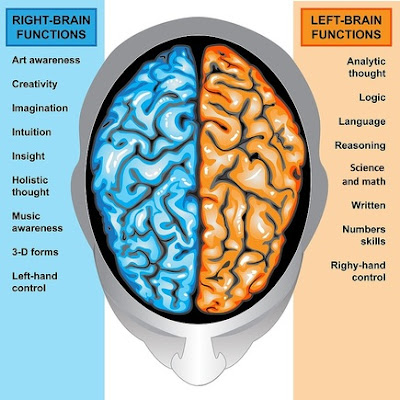
Psychology 9-1 GCSE - 4.1.2 - Understand the lateralisation of function in the hemispheres, including: a) Asymmetrical function - Ellegood et al found that 'autistic' mice showed more symmetry between the left and right hemispheres of the cerebellum when compared to controls without mutations in the autism genes. Interestingly, the 'autistic' mice showed more asymmetry between the left and right hemispheres of the cerebellum. A wide range of studies have found that cerebellum size and functional connectivity is correlated with autism-related functions. Such as emotion, regulation and attention. b) Role of the left hemispheres - c) Role of the right hemispheres - Brain hemispheres and their functions d) Role of the corpus callosum - The corpus callosum consists of about 200 million axons that interconnect the two hemispheres. The primary function of the corpus callosum is to intergrate motor, sensory ...
Psychology 9-1 GCSE - 4.1.1 - Know the structure and function of the brain, including: a) Temporal - This is located on the bottom section of the brain. This is also the location of the primary auditory cortex, which is important for interpreting sounds and the language we hear. This portion of the brain is also heavily associated with the formation of memories. Damage here can lead to problems with memory, speech perception and language skills. b) Occupital - This is located at the back portion of the brain. It is associated with interpreting visual stimuli and information. Damage here can cause visual problems such as difficulty recognising objects, inability to identify colours and trouble recognising words. c) Frontal - This is located at the front of the brain, it is associated with reasoning, motor skills, higher level cognition and expressive language. Damage to the frontal lobe can result in changes in sexual habits, socialisation, at...
Psychology 9-1 GCSE 1.1.1 - Understand early brain development, including the development of: a) Forebrain - Also called the proencephalon, the forebrain is the largest part of the brain. It is divided into two cerebral hemispheres connected by the corpus callosum (white matter). The surfaces of the hemispheres are made up of grey matter called the cerebral cortex. Your cortex has roles in perception, memory and all higher thought processes. Both hemispheres are split into 4 lobes (frontal, perietal, occipital, temporal). In the brain region there are three structures; thalamus, hypothalamus and pituary. Thalamus is for organizing sensory information. Hypothalamus is in charge of your endocrine system which transports hormones. It also controls thermal regulation (your internal temperature). Pituitary also helps control the endocrine system b) Midbrain - The midbrain serves as a vital connection point between the forebrain and the...